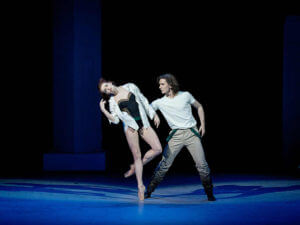
Eifman Ballet of St. Petersburg returns to New York City on April 6-8, 2018 with a ballet Anna Karenina
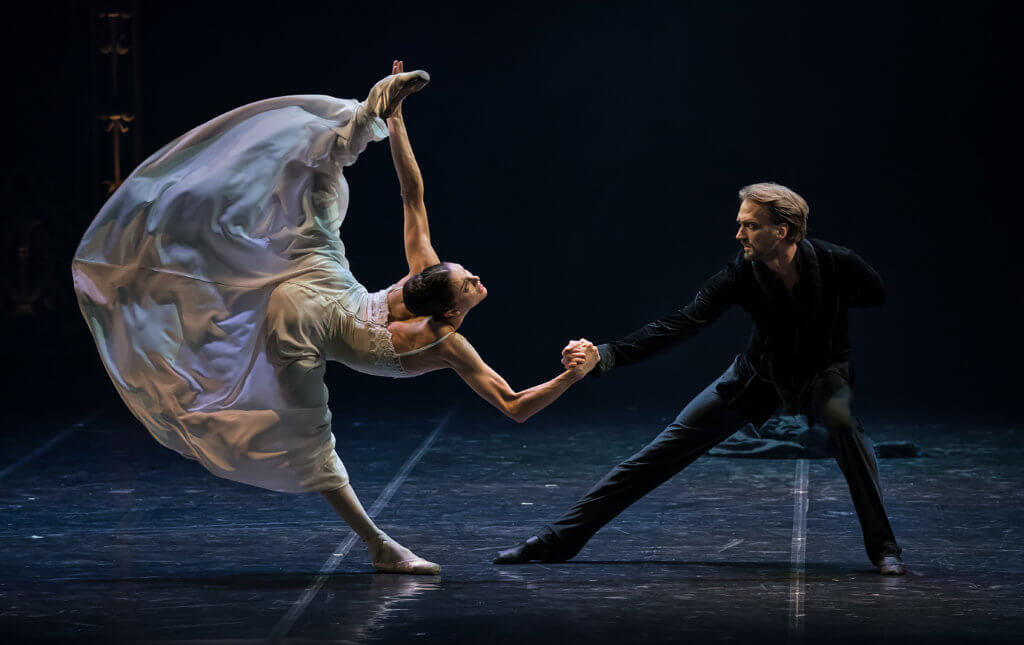
Anna Karenina / Image courtesy of Ardani Artists Management, Inc.
Eifman Ballet of St. Petersburg is well-known on New York City dance scene. Its performances are eagerly anticipated by the fans of Russian ballet. Boris Eifman, the founder, and creator of this ballet theater, chooses complex psychological stories as the basis for his repertoire requiring from the spectators to know the literary text or the historical intricacies and to be able to appreciate a very abstract form of expression such as dance. In the case of Anna Karenina ballet, he obviously takes the cues from Leo Tolstoy but zeroes in on its main love triangle Anna-Vronsky-Karenin leaving aside the rest of Tolstoy’s characters. The show is dramatically staged and performed by the top-class classically trained dancers of Eifman Ballet theater. The performances in New York City will be taking place at the David H. Koch Theater on April 6-8, 2018. Book your discounted tickets with a promo code TNTIX here.
Jessica Lang Dance with Orchestra of St. Luke’s in Stabat Mater on November 1-2, 2017
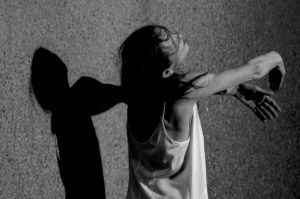
Jessica Lang’s production of Pergolesi’s Stabat Mater / Photo credit: Karli Cadel / Image courtesy of Glimmerglass Festival
White Light Festival presents a New York premiere of Jessica Lang Dancecompany production of Pergolesi’s Stabat Mater on November 1-2, 2017. This year the festival is focusing on faith and its humanistic inspirations. Sacred music of Psalms is a perfect medium to highlight the sorrow, compassion, and hope for redemption and peace. Pergolesi’s delicate and sensitive music in Stabat Mater is being masterfully combined with the fluidity and lightness of movements by Jessica Lang’s dancers.
Pergolesi was born Giovanni Battista Draghi in Jesi, Italy which at the time was part of Papal States. Because his family was originally from Pergola, he was given a nickname of Pergolesi which was a common practice at the time.
Counter Tenor Anthony Roth Costanzo performing in Jessica Lang’s production of Stabat Mater / Photo credit: Karli Cadel / Image courtesy of Glimmerglass Festival
Pergolesi is best known for his sacred opus Stabat Mater which was finished in 1736 right before the composer’s death from tuberculosis at age 26. The piece was written for an annual meditation on Good Friday in honor of the Virgin Mary. Pergolesi’s Stabat Mater had replaced the score by A. Scarlatti. Sacred psalms were not the only musical genre favored by the composer. Pergolesi’s operatic works made strong influence on his contemporaries and helped to establish the wide popularity of opera buffa. His operas were performed in Naples, Rome as well as Paris where they resulted in some tensions between those who preferred a more serious style over the new winds of theatrical productions.
The original music score for Pergolesi’s Stabat Mater was composed for soprano and alto soloists, violin I and II, viola and basso continuo (cello and organ). The recoding by London Symphony Orchestra with Claudio Abbado conducting is considered a staple of the sacred music genre.
So powerful is the music of Pergolesi that it made a place for itself in the modern world of movies and films. One of them, Farinelli (1994), a highly acclaimed Italian/French movie, was awarded the best foreign language film at the Golden Globe in 1995 and was nominated for an Academy Award in the same category.
Jessica Lang and her dance company had premiered this production of Stabat Mater at the Glimmerglass Opera Festival in 2013. The lightness of the company dancers’ movements and the melting of gestures to the music are the hallmarks of this company style. They blend incredibly well with the delicate voices carrying the melody making a natural extension of the music projecting it into space.
White Light Festival is being presented by the Lincoln Center. With the NewYorkPass your can enjoy a free tour of the historic Lincoln Center and much more. The New York Times calls the White Light Festival “the psalms bonanza” presenting “a dozen concerts featuring 1,000 years of music by composers including Bach, Handel, Telemann and Arvo Pärt”.
Historic double bill of Café Müller/The Rite of Spring on September 14-24, 2017
Pina Bausch, Photo Credit: J. Paolo Pimenta / Image courtesy of BAM
This year Tanztheater Wuppertal Pina Bausch brings to New York two extraordinary ballets Cafe Muller set to the music of Henry Purcell and Igor Stravinsky’s The Rite of Spring. The psychological complexity conveyed by the Bausch’s powerful choreography will without doubt touch the souls of everyone from the dance aficionados to the novices to the art of ballet. The performances are part of the Next Wave Festival at BAM which will run from September 14 till December 16, 2017.
Pina Bauschand her theater Tanztheater Wuppertal had made a New York debut in 1984 and became highly anticipated guests on NY dance scene from that time on.
Bausch formal dance education started when at the age of 15 she was accepted to Folkgangschule of North Rhine-Westphalia, Germany to study under the direction of Kurt Jooss, a pioneer of dance-theater genre who connected the ballet with the theatrical drama. After graduating the Folkgangschule, Bausch studied at Juilliard School in New York in the early 60s and was part of the New York Ballet, Paul Taylor company and other groups. Returning to Germany in late 60s to continue her work with Jooss, she choreographed her first ballet Frangmente to the music of Bartok in 1968.
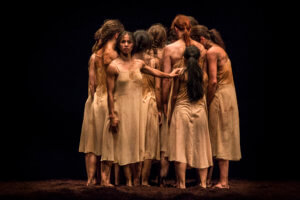
From The Rite of Spring, Photo Credit:Ludovico Bastianini / Image courtesy of BAM
Assuming the role of artistic director for the Wuppertal Opera ballet in 1973, she continued to produce new ballets thus developing the style of tanztheater.
For the performances at BAM, Tanztheater Wuppertal will perform Cafe Muller and The Rite of Spring. Cafe Muller (1978) likely includes autobiographical elements, as Bausch family had also owned a café where Pina, still a child, had made her first dance performances entertaining the guests. In the ballet, the dancers make sleepwalking movements in a dark, deserted café interior acting out a tale about human emotions which are flaring up under the covers of night. Or it could be child’s interpretation of the complex and scary world of the grownups. The Guardian reviewof the piece for its 2008 performance at Sadler’s Wells, London, notes that the characters are “trapped in an existential tape loop, they endlessly reprise their actions and interactions.” Amplifying the effect are the arias by Henry Purcell mixed with the moments of silence. The repetitive movements seem to suggest that the characters are about to break themselves free but in the end are unable to do so.
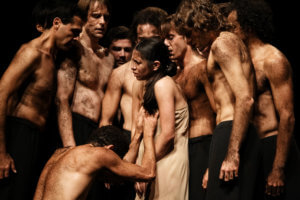
From The Rite of Spring, Photo Credit:Oliver Look / Image courtesy of BAM
The second part of the bill is The Rite of Spring (1975) to the powerful score of Igor Stravinsky. In Bausch’s take of this ballet, which was originally written for Ballet Russes and choreographed by Vaslav Nijinsky, it at times seems that the dancers’ movements are making the music itself so close the choreography is in following the score. For this piece the stage is covered with dirt which plays a part in the performance. It is a character in the storyline along with the tribe and its rituals. The powerful and muscular movements of the male group are accentuated by the sensual and gentle actions of the female performers. This contrast between the sexes leads up to an emotional rite of the sacrificial selection by the tribe and its triumph over the individual expression and freedom. The ballet is so powerful that at time it feels like the composer and the choreographer were literally working together. Time is powerless to separate the geniuses of the music and choreography creators.
Nothing beats seeing the live performance but Chantal Ackerman’s documentary One Day Pina Asked shows how the danztheater is being made.
Elegant and witty choreography, superb technique, a swirl of energy – what else can one wish to see at the ballet performance? The fans of this colorful art genre will be absolutely delighted to see this smart staging of the classic tale of the battle of the sexes. Ballet de Monte-Carlo director-choreographer Jean-Christophe Maillot masterly production of W. Shakespeare play for the Bolshoi to the selected compositions by D. Shostakovich had won a strong acclaim from the time of its opening in 2014. The Telegraph review praised Maillot choreographic style as “an eclectic, high-octane and often witty fusion of classical and modern”.
Bolshoi Ballet dancers bring their well-known mastery to the high-speed love story. The Guardian review points to “mesmerizing” rendering of Katarina’s role by Ekaterina Krysanova and “hypnotic energy” of Vladislav Lantratov as Petruchio. The rest of the main characters and ballet cast are as articulate and infectious in telling the story as the principals. In the critics’ opinion the high-speed of the production is the only comment that can be made. The rest is just a sheer joy!