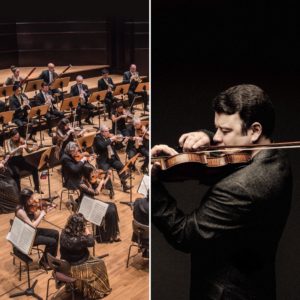
World premiere arrangement for chamber orchestra of Tchaikovsky’s beloved collection of piano vignettes The Seasons and Vivaldi’s The Four Seasons will be performed at Carnegie Hall on Saturday, January 25, 7PM
Jessie Montgomery and Jannina Norpoth’s world premiere arrangement of Tchaikovsky’s endearing collection of piano miniatures The Seasons is paired with Vivaldi’s The Four Seasons, performed by violinist Vadim Gluzman with the insight and warmth that make him one of Orpheus’ favorite collaborators.
Program:
TCHAIKOVSKY arr. Jessie Montgomery and Jannina Norpoth: The Seasons, Op. 37a
VIVALDI: The Four Seasons
Tickets start at $25 | Student tickets are $15 | Groups of 8 or more save 25%
A retrospective of works by conceptual artist Hans Haacke at the New Museum is the first major survey of the artist’s works in 30 years. It presents the artist’s oeuvre from the 1960s to the present.
Renown in the art world for his interest in the systems, from mechanical to environmental to social, Haacke’s explorations in the field of investigative art made a splashy headlines in 1971 when his exhibition at the Guggenheim Museum was canceled because it included Shapolsky et al Manhattan Real Estate Holdings, a Real-Time Social System which probed the real estate dealings of the landlords of Manhattan’s slums. This time Shapolsky et al is on view at the New Museum.
The exhibition also includes Haacke’s kinetic and mechanical art which was created at the start of his career in Germany in the early 1960s. It progresses throughout the years to the recent Make Mar-a-Lago Great Again arrangement from 2019.
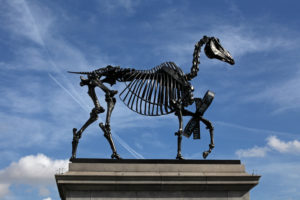
Spread over the four floors and the lobby, there are loaded installations that cover such topics as the troubled corporate sponsorship of the arts, the duplicity of business culture, and the societal biases in how the public values and appreciates the art. Haacke’s famous entry for the Fourth Plinth project was Gift Horse, 2014. Conceived in 1998, the project selects artwork for a temporary exhibition on the unoccupied corner on the Trafalgar Square in London. A tribute to Scottish economist Adam Smith, the bronze skeleton of the thoroughbred with the electronic ribbon which displayed the ticker feed from the London Stock exchange (for the exhibit at the New Museum it displays a feed from the New York Stock exchange) was commissioned by the Mayor of London to stand alongside the permanent sculptures of King George IV and the two generals Henry Havelock and Charles James Napier.
The exhibition is a strong reminder about the societal disharmonies of the past and current times. Stroll through the galleries, ponder over the peculiar physics of wave formation or condensation process which are the subjects of Haacke’s early period, participate in the museum visiter’s survey as a participatory piece of art, and get deep into an uneasy relationship between the business and the art.
The best musical revival in every aspect, this dynamic production is a must see in New York City this year; playing until January 2020
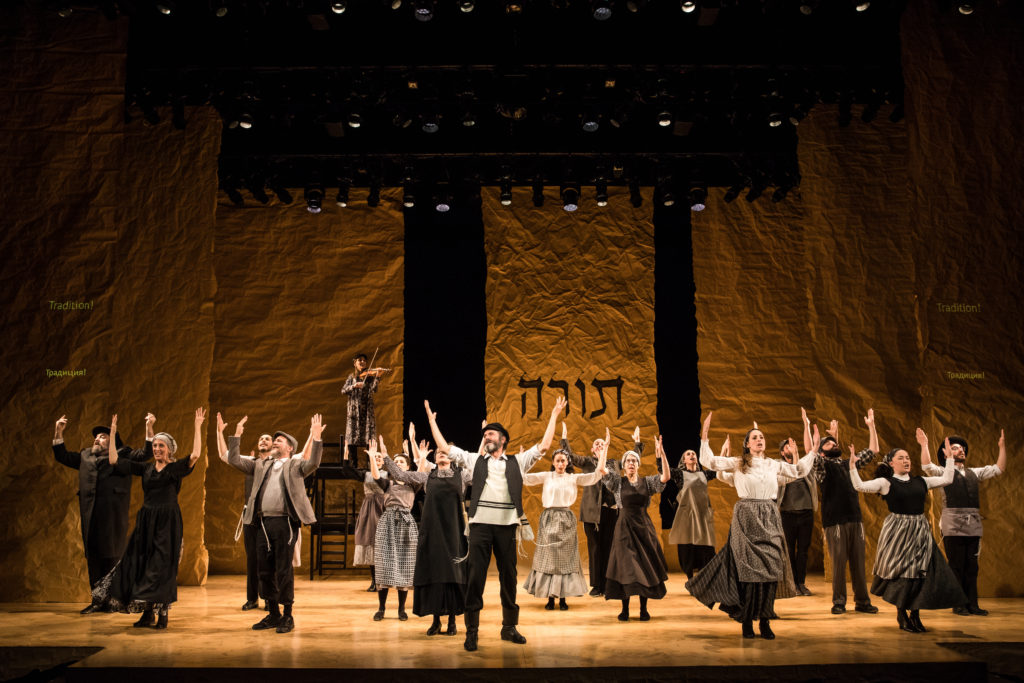
The company of Fiddler on the Roof in Yiddish (c); photo Matthew Murphy
The National Yiddish Theater Folksbiene’s production of Fiddler on the Roof performed in Yiddish reconnects the spectators with the past and reminds them about eternal tensions between new ideas and the traditional ways of life. Joel Grey’s production was initially-planned for a 6 week run at the Museum of Jewish Heritage in downtown Manhattan in the summer of 2018. This production experienced the sort of miracle akin to the Hanukkah oil lasting much longer than intended. After the original run was extended three times till the end of 2018, the musical was brought to commercial production at the Stage 42 Off-Broadway theater on February 2019. It is now scheduled to run until January 2020.
Jerry Bock’s familiar music combined with the genuine acting by the cast led by affable Steven Skybell as Tevye, Jennifer Babiak as Tevye’s unswerving wife Golde, Jackie Hoffman as a meddlesome matchmaker Yente, and a superb orchestral accompaniment recreate the life in Anatevke in the early 20th century Russian Empire.
Perhaps, because of the universally well-known songs and the engaging acting, one only realizes that the play is performed in Yiddish, the language spoken in poor shtetls of nowadays Ukraine, when the story is already in full swing. With the helpful subtitles in both English and Russian, everything quickly falls into place. The actors’ energy immediately takes the audience in, so that they become one close community sharing its collective heritage. Without trying to keep the emotions hidden, the audience celebrates, questions, and fights with Tevye, his family, and his neighbors. It is a rare gift of unity worth taking part in. Come see the company of The National Yiddish Theater Folsbiene recreating the timeless story of love, traditions, and change. Click below for tickets at 62% off starting from $45.
Pyotr Ilyich Tchaikovsky’s opera about the vices of gambling and greed is performed at The MetOpera by the impressive international cast
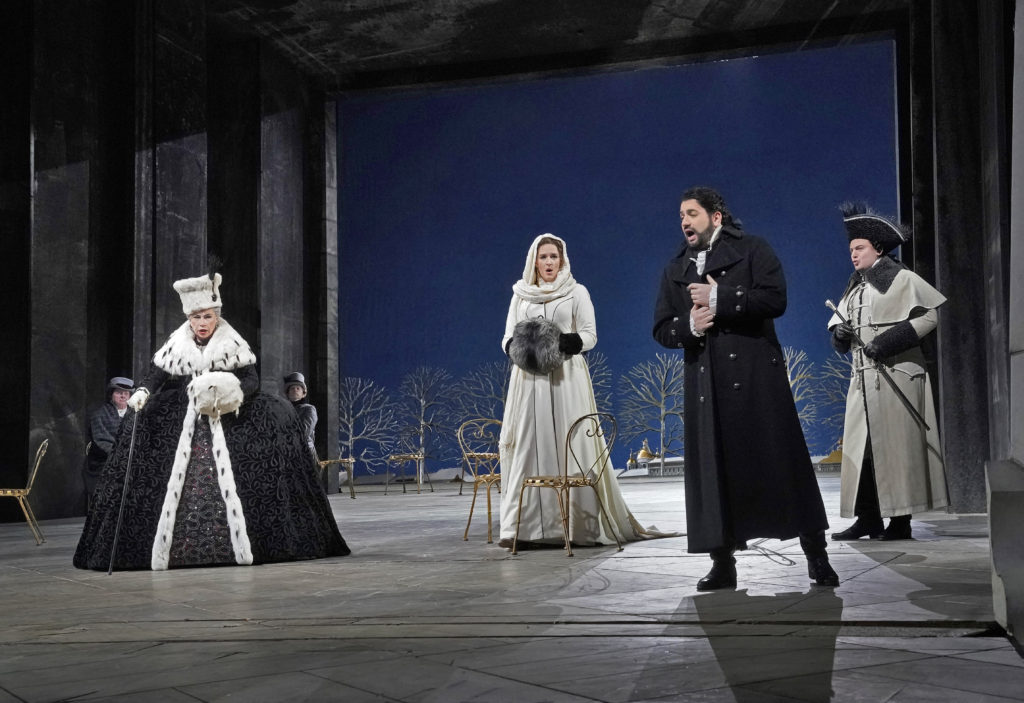
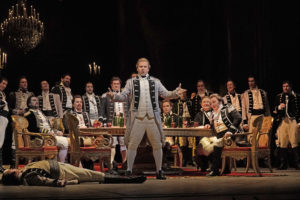
Larissa Diadkova as the Countess, Lise Davidsen as Lisa, Yusif Eyvazov as Hermann, and Igor Golovatenko as Prince Yeletsky in Tchaikovsky’s “The Queen of Spades.” Photo: Ken Howard / Met Opera
Mysterious and alluring, the Imperial Russia of Catherine the Great’s time takes the stage of the Met Opera this December. The critics call The Quees of Spades, a masterpiece created by Pyotr Tchaikovsky, the highlight of the season so far. The splendid and imperially rich set and costume design by Mark Thompson recreates the times of extreme fashion, endless balls, and futile gambling and drinking nights. Premiered in 1995, Elijah Moshinsky’s production of The Queen of Spades is also memorable to the opera fans for Dmitriy Hvorostovky’s debut at the Met Opera.
This year’s production features a superb cast of international stars with a radiant soprano Lise Davidsen as Lisa, an expressive tenor Yusif Eyoavazov as Hermann, impeccable baritones Igor Golovanenko and Aleksey Markov as Tomsk and Yeletsky, and a moody mezzo-soprano Larisa Diadkova as the countess. The conductor Vasily Petrenko makes his debut on the Met stage and takes full control of the splendid music score, leading the musicians in perfect alignment with the singing and acting.
Alexey Markov as Count Tomsky in Tchaikovsky’s “The Queen of Spades.” Photo: Ken Howard / Met Opera
Davidsen’s stormy entry into the opera world can only be fully appreciated when her powerful performance is observed on stage. With an understatement so suitable for Lisa, a young Russian lady of modest means, Davidsen uses her vocal strength to deliver the angst and desperation because of her lover’s betrayal in the name of material possessions. The colorful and exquisitely designed chorus scenes contrast with the gloomy mood and greedy aspirations of the high society. But the gorgeous music and the impressive signing save the day to the elation of the audience.
The opera is sung in Russian with subtitles; run time 3 hours and 35 minutes with one intermission. Performances are from December 5 – 21, 2019.