Verdi’s masterpiece about a court jester Rigoletto returns to the Metropolitan Opera in February with more performances in March and May 2019
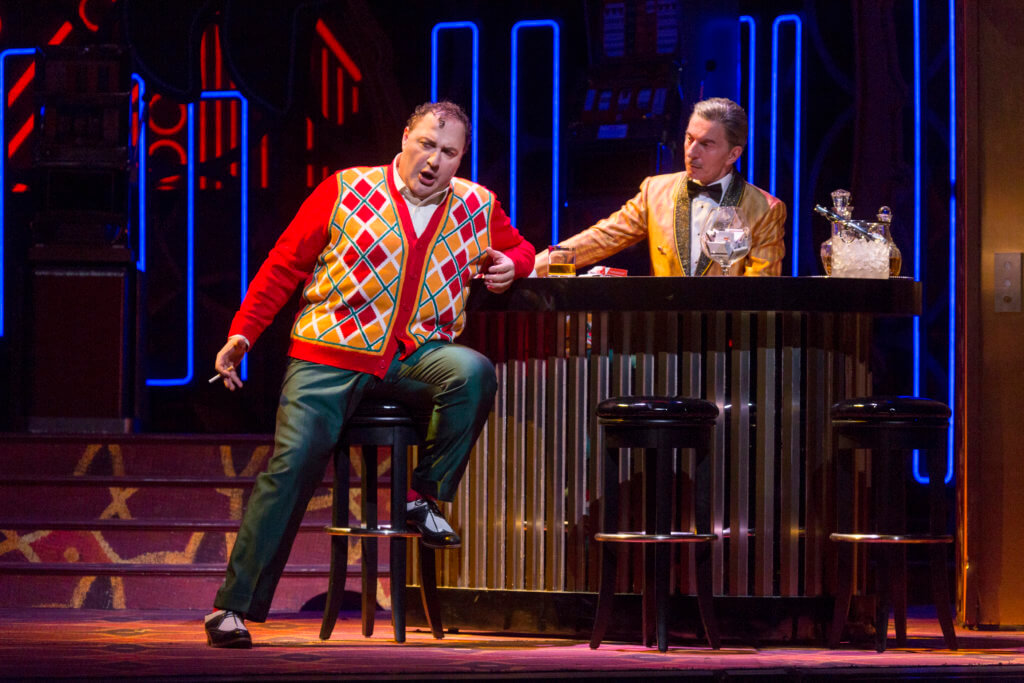
George Gagnidze in the title role of Verdi’s Rigoletto. Photo by Richard Termine/ Metropolitan Opera.
Rigoletto in Las-Vegas? Verdi’s extremely popular opera set to a powerful play by Victor Hugo seems to be destined for any epoch and impervious to the time and place transformations. With an ever-relevant fable and beloved arias widely familiar to opera fans and recognizable to those new to the genre, this opera is a time-tested favorite of every opera house.
Shifted to Las Vegas in the 1960s, Michael Mayer’s 2013 production of Rigoletto gets a modern look while telling the same centuries-old story of corruption, evil and love. While the power of the old man curse put at the center of the tale seems less believable in the 20th century, the dirty intrigues and the ruthlessness of the lonely figures doing shady business look rather plausible.
For the last four performances of Rigoletto in this season production at the MetOpera, the cast includes the highly-acclaimed baritone George Gagnidze as a tragic jester with Matthew Polenzanni taking on the role of amoral Duke. Rosa Feola sings innocent Gilda.
Splendid and colorfully rich production of Arrigo Boito’s Mefistofele at the Met Opera until December 1, 2018
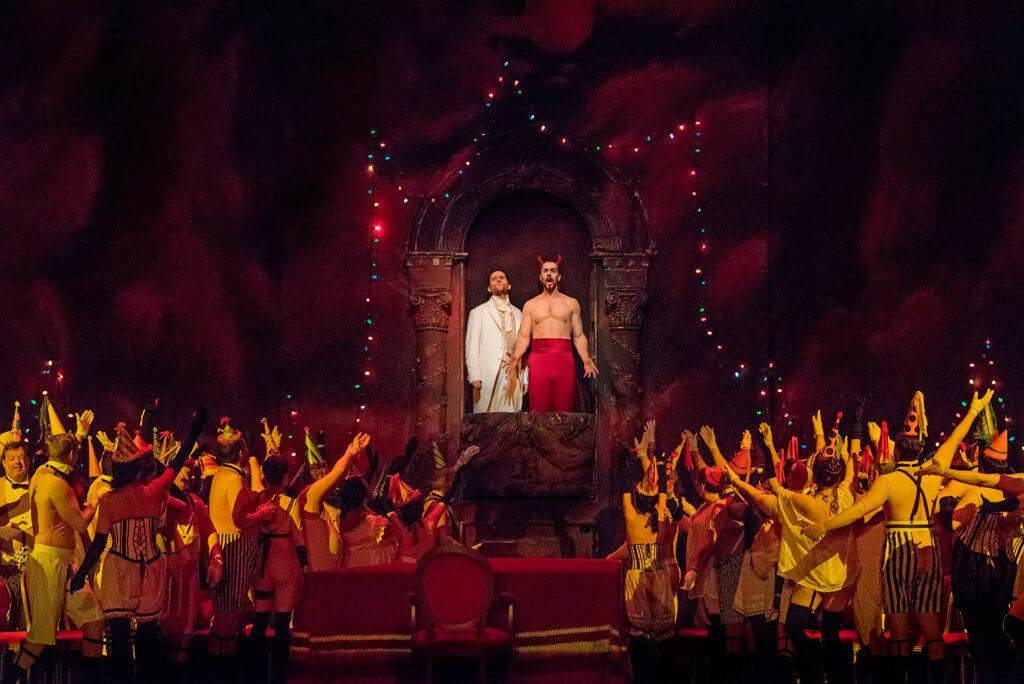
Michael Fabiano as Faust, Christian Van Horn in the title role of Boito’s “Mefistofele.” Photo: Karen Almond / Met Opera
A revival of Robert Carsen’s the 1999 production of Boito’s Mefistofele brings all the elements of grand opera to the Met Opera stage. Omnipresent and vicious devil whistling and steering havoc, magnificent chorus scenes mightily delivered by the members of Met chorus and ballet, vibrant costumes and powerful singing are all in evidence throughout the performance.
Regarded as a showpiece for basses with Samuel Ramey famously singing Mefistofele with all the demonic charisma in place, Christian Van Horn, a bass-baritone, commands a formidable presence. Faust, his counterpart, played by young tenor Michael Fabiano, is reasonably sensual if restrained at times. Yet, both make an impressive leading pair going through all the ups and downs of Boito’s illustrious masterpiece.
The set and costume design by Michael Levine adds a strong visual component to the production and sometimes competes for attention with the music and the main characters. With sensitive and penetrating soprano Angela Meade as Margherita and Carlo Rizzi conducting, the opera is a fantastic treat for the spectators reminding us of vices and virtues in a truly theatrical way.
Vibrant production by Sir David McVicar of the beloved Verdi’s opera on January 22 – February 15, 2018
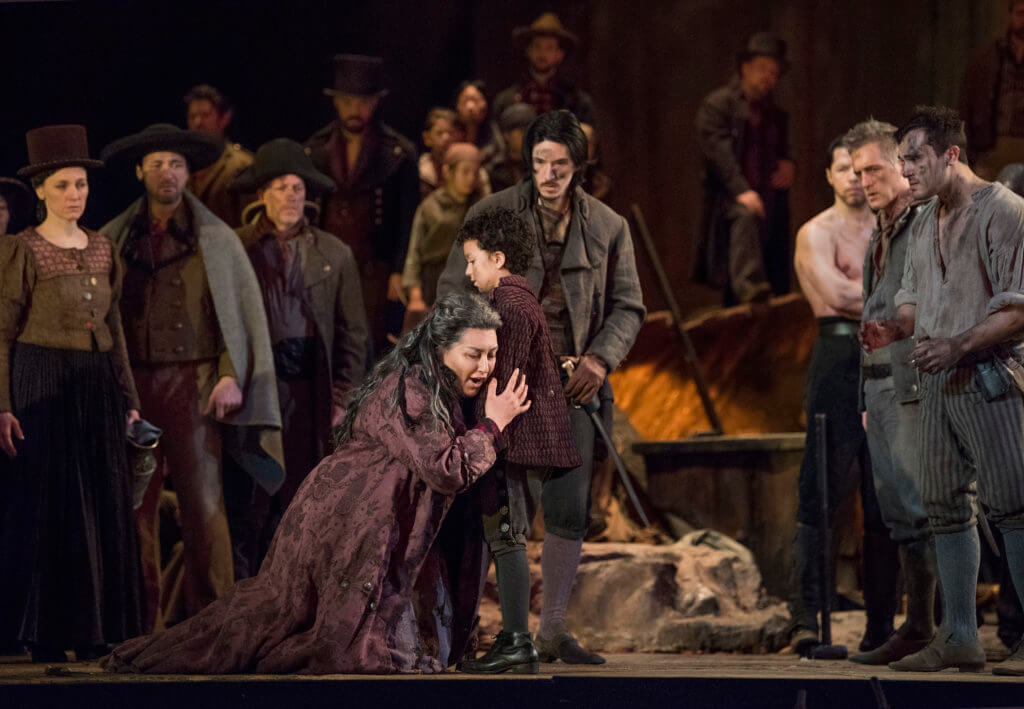
Anita Rachvelishvili as Azucena in Il Trovatore/ Image courtesy of the Met Opera NYC
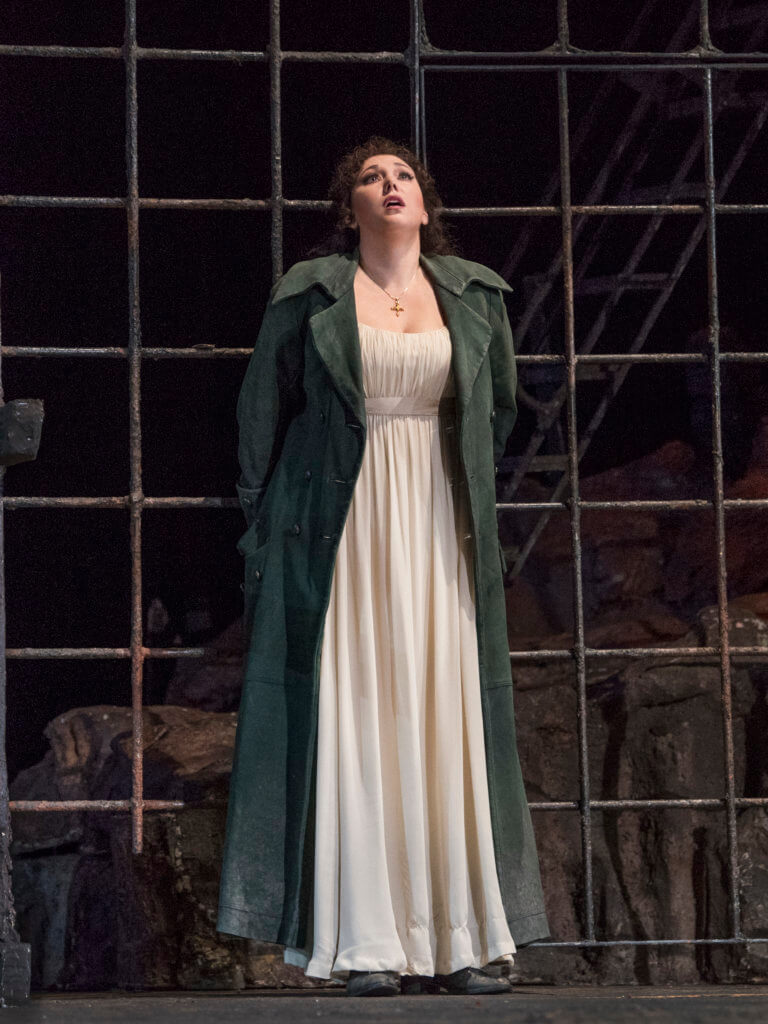
This year repertoire at the Met Operais clearly dominated by Sir David McVicar’s productions. Il Trovatore, which first had opened here in 2009, is returning to the Met stage with a formidable cast under the baton of Marco Armiliato. The title role in this production is forcefully performed by Yonghoon Lee, the role of his lover Leonora is sung by Jennifer Rowley and the role of Count Di Luna is performed by the baritones Quinn Kelsey and Luca Salsi. After the opening on Monday, January 22, the praising reviews were given to the magnificent Georgian mezzo-soprano Anita Rachvelishvili performing the most complicated part of the opera, a gypsy Azucena. Book your tickets here.
Jennifer Rowley as Leonora in Il Trovatore / Image courtesy of the Met Opera NYC
Il Trovatore’s catchy, disturbing and at the same time melodic music score is overplayed on a macabre plot of medieval rivalries, superstitions and love stories. It is based on a successful play El Trovador (1836) by Antonio García Gutierrez. Verdi had started the work on this opera sometime in 1850 first with the librettist Salvadore Cammarano and later after Cammarano’s death in 1852 with young poet Leone Emanuele Barware. In his correspondence with Cammarano Verdi kept asking him for packing more actions in the libretto to make the most effect on the public. The librettists seem to succeed in that regard. Notwithstanding opera’s great acclaim by the audiences around Europe, the plot was mocked in numerous satires in Italy and elsewhere, which in itself was a sign that its a hit. The twists and turns of the original tale are transformed in this production from the very distant beginning of 15th century Aragon, Spain to the time of the Spanish War of Independence (1807-1814) fought against Napoleonic France. The bitterness and horrors of that period are memorialized in Goya’s “Desastres de la Guerre.”
The creators of this production felt that the time of Peninsular War “fits with Verdi’s tinta, the dark palette he creates for Spain” as McVicar pointed out in an interview with the New York Times. However, some critical elements of the plot in Il Trovatore particularly those surrounding Azucena and her fate seem to be mooted for early 1800. While in the gypsy folk tradition the fire is believed to be the means of communication with the dead, it makes sense for gypsy Azucena’s story and its horrific prominence in the original play set in the 15th century as burnings of sorceresses at the stake were widely practiced. At the time of Napoleon, the use of that practice is highly questionable.
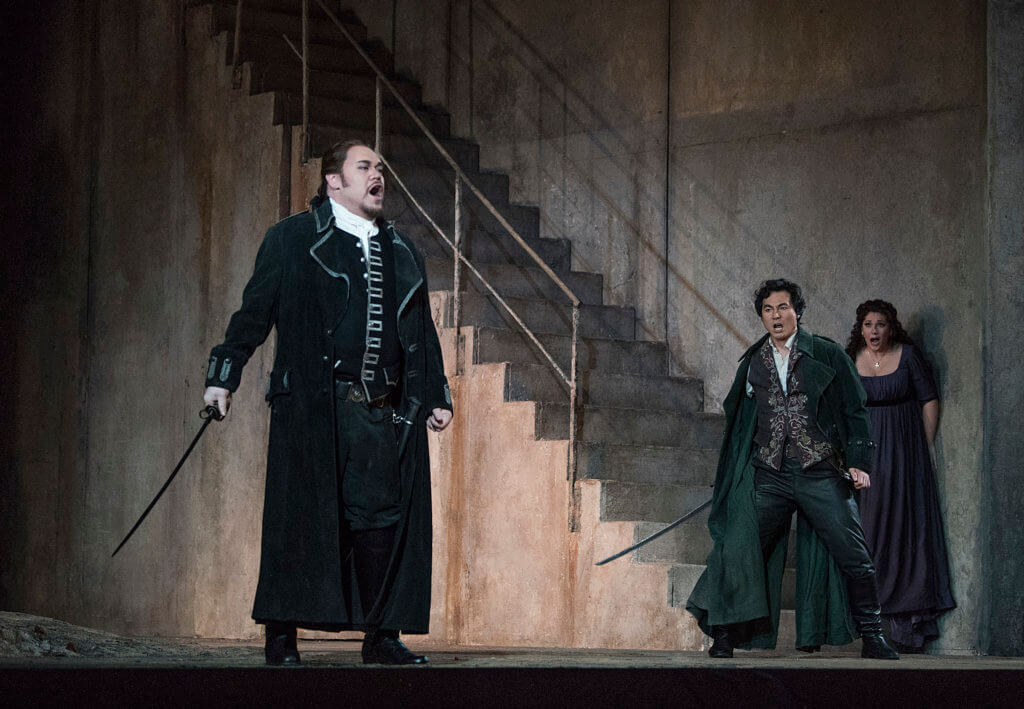
Quinn Kelsey as Count Di Luna, Yonghoon Lee as Manrico, Jennifer Rowley as Leonora in Il Trovatore / Image courtesy of the Met Opera NYC
Despite the pitfalls of historic transposition, Anita Rachvelishvili as Azucena is taking a center stage with her dramatic performance. It’s one thing for Azucena to sing “It makes my blood run cold”, and its very different when the delivery of the lines makes the listeners’ blood cold. “Well, it fairly freezes in your veins while watching and listening to Anita Rachvelishvili” observes Z. Wolf in his New York Times review. Rachvelishvili powerful stage presence masterfully switching from the chilling scenes of tormenting madness to the touching desperation is particularly important here. Verdi himself was thinking about Azucena as a main female character in this opera and even wanted her name to be in the title. The Met orchestra under Armiliato conducting provides superb and inspiring music. With the rest of the main cast being well-placed, the production delivers a deep and spirited theatrical impression.
Starting from 1853 when it was first performed at the Teatro Apollo in Rome, Il Trovatore entered the repertoire of every major opera house in the world. There is a rich and diverse discography with multiple variations of the best singers and conductors. Its catchy melodies had even entered the popular culture and were used in the movie and TV productions.
An eternal tale of seduction and religious devotion
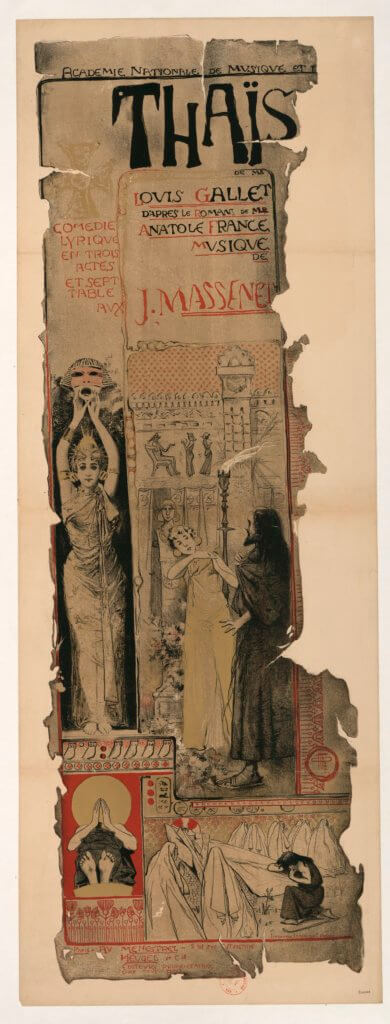
By Manuel Orazi – Gallica, Public Domain
MetOperarevival of Thaïs production from 2008 is a passionate story about love and faith aptly delivered by Ailyn Perez in the title role and Gerald Finley as Athanaël, the holy monk. It is centered on a timeless struggle between the allure of the flesh and the piety of the spirit. The narrative and the score are charged with high emotions and endless desperation in search of harmony and salvation accentuated by Massenet’s highly recognized Meditation, the entr’acte for violin and orchestra.
Jules Massenet (1842-1912) wrote his wildly popular opera Thaïs, a comédie lyrique when his career as the most prolific French operatic composer was already well established. Thaïs has premiered at Opera Garnierin Paris in 1894 and gained widespread recognition shortly after at its first revival four years later. A libretto by Louis Gallet was based on the novel of the same title by Anatole France (1844-1924), a French poet, journalist and novelist. While Massenet’s other operas, Manon and Werther, are among the most performed, Thaïs holds its place for its exotic musical renditions, curious historical elements and the depth of emotions.
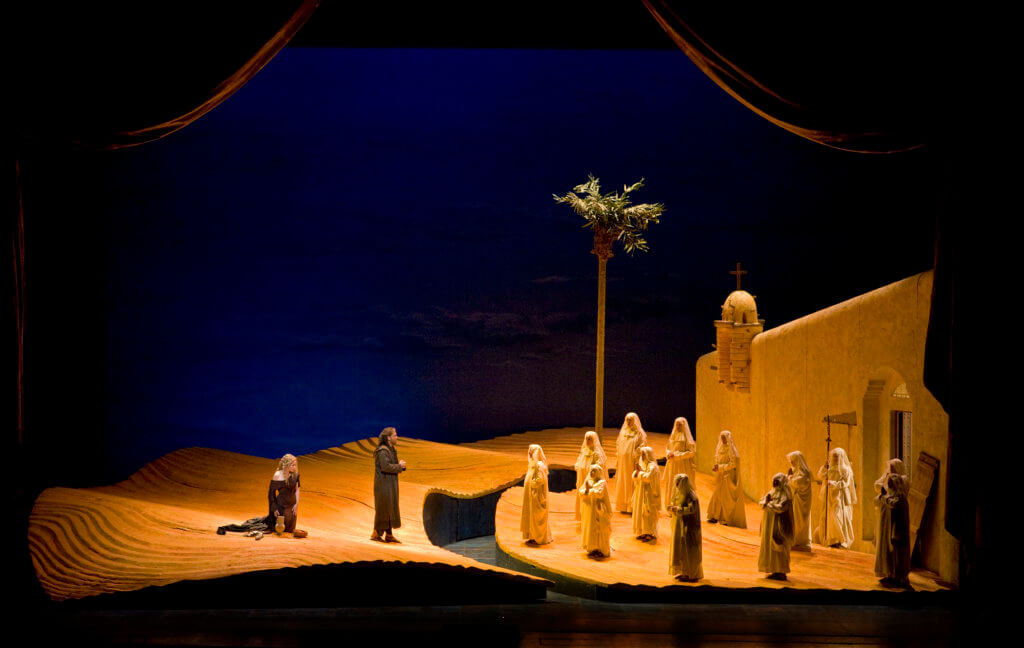
A scene from Act III of Massenet Thais, Photo: Ken Howard / Image courtesy of Metropolitan Opera
Anatole France’s story of the rich courtesan living in Alexandria, Egypt in around 4th century AD followed a legend known in Christian literature as the life of Saint Thaïs of Egypt. A servant of goddess Venus, she used her sensuality to seduce an ascetic Cenobite monk who was persuading Thaïs in his own efforts to convert her to Christianity. The plot is revolving around a power play between the earthy pleasures and a blind faith. And while in France’s story the Christian devotion takes a firm hold on the volatile spirit of a former sinner ultimately leading to her repentance and a vision of heaven, it could be interpreted as a dead-end in itself. On the other hand, the very earthy feelings awaken in the heart of a former monk, are showing a passage to real experiences and with that a possibility of reawakening. Some of the former productions of the opera led to a controversy around religious eroticism and irreversible tenets of belief. The role of Thaïs, which is notoriously difficult to sing, was written by Massenet for an American soprano Sibyl Sanderson.
A memorable performance of Thaïs on the MetOpera stage in 2008 season with Renee Fleming in the title role and Thomas Hampson as the desperate Athanaël, is released by Decca records.
Date and Discounted Tickets with the codeTICKETS3:


 succeed in that regard. Notwithstanding opera’s great acclaim by the audiences around Europe, the plot was mocked in numerous satires in Italy and elsewhere, which in itself was a sign that its a hit. The twists and turns of the original tale are transformed in this production from the very distant beginning of 15th century Aragon, Spain to the time of the Spanish War of Independence (1807-1814) fought against Napoleonic France. The bitterness and horrors of that period are memorialized in Goya’s “Desastres de la Guerre.”